
Over the past three years, Begi Bistan has taken part in the European OSES project (Ocean Sustainability through Education and Sport), an initiative focused on promoting environmental education through nautical sports.
Together with nine European organizations, the objective has been clear: to demonstrate how activities in aquatic environments can become a real tool for fostering sustainability, ocean literacy, and action against climate change.
Sport in aquatic environments as a tool for environmental education
Direct contact with aquatic environments makes sport an especially effective channel for environmental education. Unlike other formats, first-hand experience on the water makes the effects of climate change and the fragility of ecosystems tangible.
In this context, disciplines such as rowing or guided aquatic activities are not only valuable as sports. They also have educational and social value, helping to build a more conscious connection with the natural environment.
What the OSES project has developed
The OSES project has worked with clubs, federations, educators, and environmental organizations to create resources that can be applied in different contexts.
As a result, three key documents have been published:
- Policy brief: recommendations for integrating sport into sustainability strategies
- Advocacy report: tools and methodologies for sports and educational organizations
- Comprehensive report: project development, European pilot actions, and results
These materials reinforce the role of sport as an active agent in environmental education and ocean protection.
Begi Bistan’s role: sport, territory, and sustainability
At Begi Bistan, we have applied this approach through our Ura Mugimenduan activity, integrating sport in aquatic environments as an experience of learning and awareness.
Our work focuses on bringing aquatic environments closer to people through an active approach that combines physical activity, environmental interpretation, and reflection on sustainability. This approach makes it possible not only to enjoy the environment, but also to understand and respect it.
Beyond the project: continuity and practical application
Although the OSES project is coming to an end, its application continues. At Begi Bistan, we continue to develop sustainable sport activities in aquatic environments, incorporating the learning and tools generated over these years.
We apply this approach in our Ura Mugimenduan activity for companies:
https://www.begi-bistan.com/mice-teambuilding-euskadi/ura-mugimenduan/
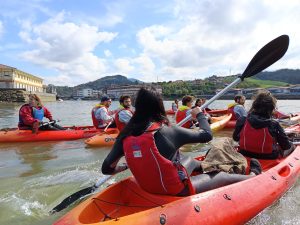
These experiences take place in the estuary, an environment directly connected to the sea, which makes it possible to work on environmental education from a real, accessible perspective closely linked to the territory.
We also bring this same approach to programs aimed at schools, adapting the content to work on environmental awareness with students through direct experience in aquatic environments.
In addition, we have a specific annual event, Behoria Garbia, a dedicated day that expands this approach and brings it into a more open and participatory format:
https://www.begi-bistan.com/mice-teambuilding-euskadi/ura-mugimenduan-2025/
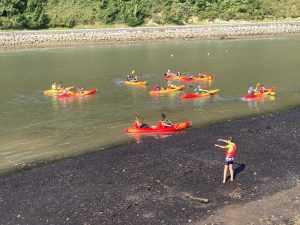
The objective is clear: to establish sport as an effective way to educate, raise awareness, and activate people in the protection of the marine environment, also from spaces such as the estuary, which are closely linked to it.
Access to the reports
All project materials can be consulted here:
https://oses-project.org/ressources-oses/
OSES project partners
The OSES project has involved nine European organizations from the fields of sport, education, and the environment:
- Sport and Citizenship (France)
- European Marine Science Educators Association – EMSEA (Belgium)
- Surfrider Foundation España
- Universitat de Barcelona (Spain)
- Surfrider Foundation Europe (Spain)
- Ocean as Common (France)
- Divers Alert Network Europe – DAN Europe (Malta)
- Ligue de Voile de Normandie (France)
- Green Coast Surfing (Portugal)
More information about the partners is available on the official OSES project website:
https://oses-project.org/the-partners-of-the-oses-project/