
Zumaia is one of the most visited destinations on the Gipuzkoa coast, mainly because of the Flysch and the Basque Coast Geopark. However, focusing the visit only on this gives a very partial view of the place.
This guide is designed to help you organize your visit properly and understand what is really worth it.
The Flysch, but properly planned
The Flysch is the main attraction, but there are different ways to experience it and not all of them offer the same result.
The most common approach is to go down to the beach, take photos and leave. This provides a very limited view.
Recommended options
By boat (the most complete option)
Route from Zumaia along the cliffs of the Geopark
It allows you to understand the real scale of the Flysch and access areas that cannot be seen from land.
On foot (more accessible but more limited)
Itzurun area and routes towards Sakoneta
💡 Clear recommendation:
Combining both options provides a much more complete understanding of the Flysch.
👉 + info
The old town: small but with content
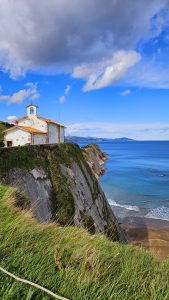
Zumaia is not a monumental city, but it has enough content for a well-planned visit.
Many people pass through this area without context and in a short time.
What to see
San Pedro Church
Old town
Old fishermen’s guild
💡 With explanation, this part of the visit gains meaning and depth.
👉 + info
Walking routes beyond the usual
Zumaia is one of the best starting points to explore the coastline on foot, but most visitors do not go beyond the most accessible areas.
Recommended routes
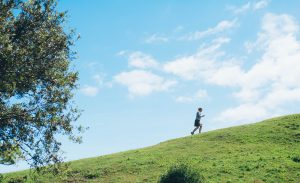
Zumaia – Deba (full Flysch route)
Zumaia – Getaria
Interpretative routes
Geology + culture + landscape
💡 The real value of these routes lies in understanding the landscape, not just walking through it.
👉 + info
Boat tours: more than just scenery
The boat is the most complete way to understand the Basque Coast Geopark.
During the route, the following are interpreted:
- The formation of the Flysch
- Geological processes
- The relationship between landscape and territor
Available options
- Guided boat tour
- Boat tour with audio guide
- Sunset boat tour (private boat)
💡 Seeing the Flysch from the sea completely changes the perception of the landscape and its scale.
Experiences that complete the visit
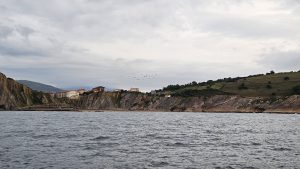
Zumaia allows you to go beyond a simple visit.
Options
- Basque culture and language
- Gastronomy linked to the sea
- Combined programs
💡 They allow the visit to be structured in a more complete and coherent way.
👉 + info
Where to eat in Zumaia
Recommendations
El Txoko de Mikel
Marina Berri
Aita Mari
How to organize your day
Half day
- Flysch (boat or short route)
- Old town
Full day
- Walking route along the Flysch + lunch (optional) + boat
- Full guided experience
Where to park in Zumaia
During mid and high season, a large part of the town center operates with regulated parking.
From here:
- Boat taxi every 20 minutes to cross to the other side of the river
- Direct connection to the town center and the beach
Payment options
- Card
- Coins
- Mugi transport card
Public transport
Zumaia is well connected by public transport, both by train and by bus.
Train
Direct connection with:
- Donostia-San Sebastián
- Bilbao
The Euskotren line runs along the coast and operates throughout the year.
Bus
Available connections:
- Donostia-San Sebastián
- Inland (up to Zumarraga)
💡 It allows you to reach the town center directly without needing a car.
Meeting point
We welcome clients directly at this point before each activity.
Conclusion
Zumaia is not just the Flysch.
It is a territory where geology, culture and landscape come together in a very compact space.
The way you visit it makes the difference between a basic visit and a complete experience.
If you want to organize your visit in Zumaia combining boat tours, walking routes and guided experiences, you can write to info@begi-bistan.com or book directly through our website.